






 Trap
 Normal
Mirror of Oaths
View:
3344
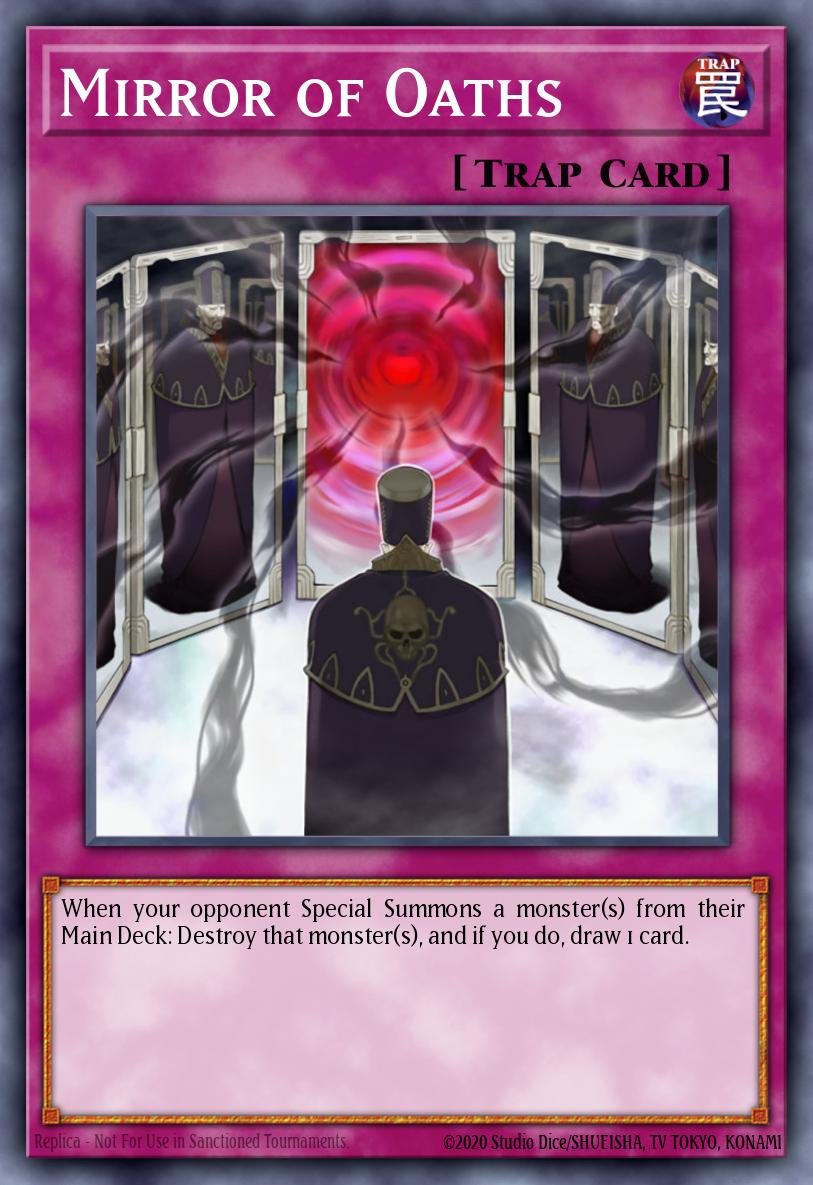
When your opponent Special Summons a monster(s) from their Main Deck: Destroy that monster(s), and if you do, draw 1 card.
Mirror of Oaths — Power Evaluation
Final Score: 54 ± 5 · Confidence: Medium
- Intrinsic: 56 · Deck: 53 · Meta: provisional
- Primary role: Board breaker / Going-second
Why it scores here
Mirror of Oaths scores as a situational removal trap with defensive potential against Main Deck Special Summon-heavy matchups. The card's strength lies in destroying opponent threats while generating a card draw; however, this is conditional on a specific summon type, which significantly narrows application. Its clean deckbuilding profile and presence across 7 distinct archetypes demonstrate solid accessibility, but the lack of combo evidence and the narrow trigger condition restrict its overall power ceiling to defensive utility.
Axis scores
| Axis | Score | Evidence |
|---|---|---|
| Accessibility | 65 | Present in 12 decks across 7 distinct archetypes averaging 1.75 copies, but requires specific opponent action to activate, limiting availability (verified). |
| Combo & Conversion | 15 | Zero combo appearances supplied, and reactive trap nature prevents self-generated board extension (verified). |
| Resource Economy | 50 | Conditional +1 card advantage on successful destruction of opponent's Main Deck Special Summon, neutral in matchups where this trigger is infrequent (inferred). |
| Effect & Interaction | 60 | Destroys opponent's Special Summoned monsters as hard removal, but limited to Main Deck summons only, reducing flexibility against Extra Deck-focused strategies (verified). |
| Material Utility | 0 | Trap cards cannot be used as material unless specified in text, and Mirror of Oaths carries no such clause (verified). |
| Resilience & Flexibility | 55 | Survives trap-heavy decks and can sit set across multiple turns, but vulnerable to spell/trap removal before opponent's Special Summon (inferred). |
| Deck-Building Efficiency | 75 | Clean inclusion at 2 copies in 75% of sampled decks with no garnet or brick risk, splashable into control/trap strategies (observed). |
Calculation
Weight profile: Board breaker / Going-second primary role. Intrinsic ≈ 56, Deck ≈ 53, Meta = provisional. Modifiers: none. Final formula: 0.40*Intrinsic + 0.60*Deck
Strengths
- Hard removal against opponent's Main Deck Special Summons
- Card draw effect provides conditional resource recovery
- Clean deckbuilding with no garnet or brick risk
- Splashable across control and trap-heavy archetypes
Weaknesses
- Conditional trigger limits activation frequency to Main Deck summons only
- No offensive combo value or board extension capability
- Vulnerable to spell/trap removal before activation
- Inactive against Extra Deck-centric strategies
Counters / choke points
- Spell/Trap destruction before opponent's Special Summon nullifies the effect
- Opponent avoidance or low reliance on Main Deck Special Summons reduces trigger frequency
- Early game draw prevents setting trap in opening turns
Best use
Defensive removal / Going-second board breaker. Decks: Eldlich, Blackwings, Control, Trap-heavy. Suggested copies: 2.
Evidence & gaps
- Verified: Card text triggers when opponent Special Summons monster(s) from Main Deck, destroys them, and draws 1 card; Present in 12 decks across 7 distinct archetypes (Eldlich, Blackwings, Vampires, Hole, P.U.N.K., Horus, Generic); Runs 2 copies in 75% of sampled decks (9 of 12); Trap cards cannot be used as material unless specified in card text
- Observed: Co-appears with Bottomless Trap Hole 66.7% of the time (8/12 decks); Co-appears with Ash Blossom & Joyous Spring 66.7% of the time (8/12 decks); Runs primarily in maindeck (12/12 decks) with zero side-deck inclusions
- Inferred: Reactive trap nature provides no combo conversion or board extension potential; Narrow trigger condition (Main Deck Special Summons only) limits effect flexibility versus broader removal effects; Conditional card draw (on successful destruction) prevents reliable resource advantage; Splashable into diverse control and trap strategies due to clean deck-building cost
- Data gaps: no combos supplied — combo conversion is text-only inference no banlist token — assumed 3 copies (unlimited) no usage statistics (StatisticsCard) — archetype inclusion percentage inferred from deck sample only only 12 decks sampled; broader inclusion data would clarify meta relevance versus niche tech status